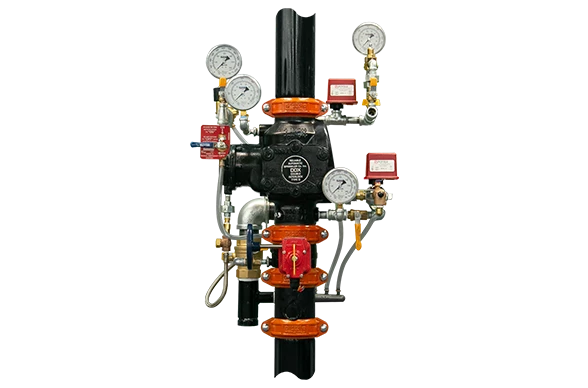
Pre-action alarm valve operates on the principle that fire suppression is triggered not only by the activation of the sprinklers but also by the occurrence of a secondary event, utilizing additional detection systems. These valves are integral components of Single Interlock and Double Interlock pre-action sprinkler systems. In Single Interlock systems, the pre-action alarm valve opens and allows water to enter the pipe system only when the detection system is activated. In Double Interlock systems, the valve opens only when both the detection system is activated and the sprinkler is triggered. These valves are used in areas where accidental water discharge could cause significant damage, such as archives, computer rooms, libraries, and museums. The operating principle relies on selecting additional detection systems that activate earlier than the automatic sprinklers, ensuring a swift response to fires.
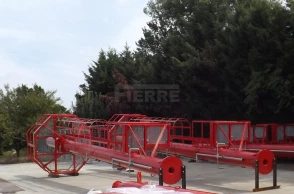
Fixed platform monitor tower can be produced with a rectangular, round or half-round platform upon request. The self-oscillating or electric monitor mounted on the platform has the capacity to rotate approximately 360 degrees. However, the stair railing that remains fixed may disrupt the jet position of the monitor in some positions. Therefore, FIERRE recommends that the monitor be rotated a maximum of 180 degrees. For higher capacity monitor rotations, a rotating platform will be suitable instead of a fixed platform.
The rotating platform monitor tower can be produced with a rectangular, round or half-round platform upon request. The self-oscillating or electric monitor mounted on the platform is capable of rotating approximately 360 degrees. Monitor towers are produced according to EN 1090 regulation
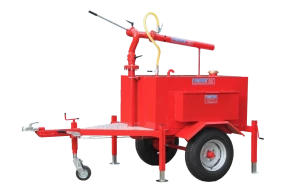
The tank of the Monitor Trailer with Tank is made of carbon steel. It can also be manufactured from stainless steel upon request. These trailers can be designed with manual monitor or self-oscillating monitor.
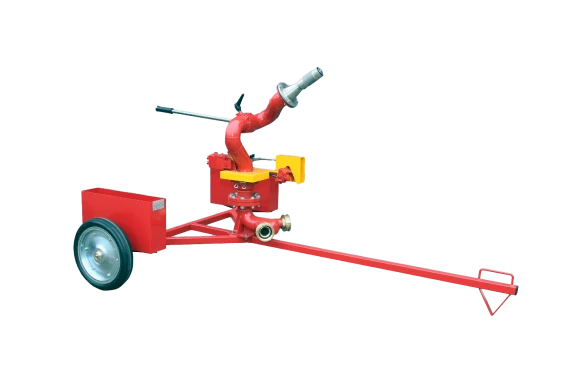
The monitor trailer is designed with a fire monitor. It is also used with a tank or foam canister.
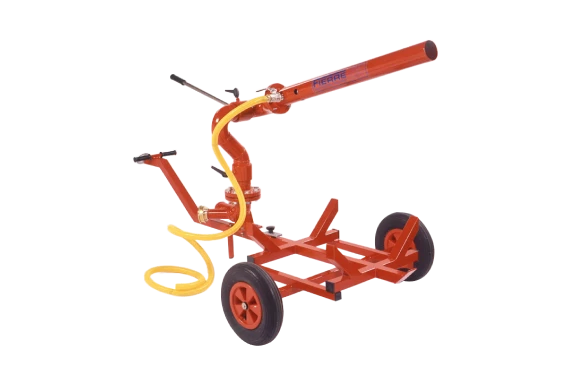
Monitor with canister trailer can be designed with a manual monitor or a self-oscillating monitor.
End-suction fire pump is a single-stage centrifugal pump that horizontally sucks in and pressurizes water. With a capacity range from 50 GPM to 1000 GPM, and pressures ranging from 65 PSI to 234 PSI, the maximum operating pressure falls between 180 PSI and 315 PSI. These pumps operate with high efficiency, are resilient to challenging conditions, and feature a motor and pump located on the same shaft. Their compact design saves space and facilitates maintenance. Approved by organizations such as Underwriters Laboratories (UL), Factory Mutual (FM), the European Union (CE), and the National Fire Protection Association (NFPA), these pumps are tested in accordance with these standards.
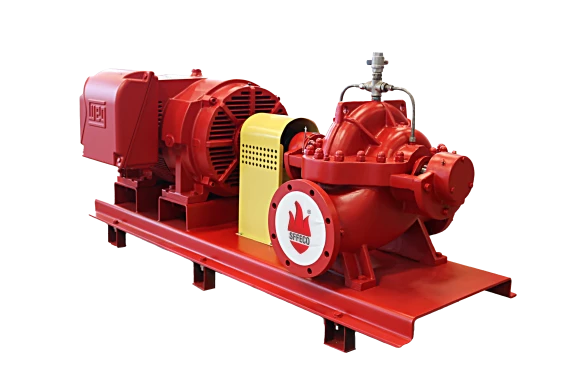
Split-case fire pump is a centrifugal pump that can be divided into two parts, offering easy maintenance and repair. Thanks to this feature, maintenance and repair tasks can be easily carried out. With a capacity range from 150 GPM to 3500 GPM, and pressures ranging from 88 PSI to 335 PSI, the maximum operating pressure falls between 220 PSI and 410 PSI. These pumps operate with high efficiency and are approved by organizations such as Underwriters Laboratories (UL), Factory Mutual (FM), the European Union (CE), and the National Fire Protection Association (NFPA), being tested in accordance with these standards.
Vertical turbine fire pumps are a specialized type of pump used in fire suppression systems. These pumps feature a vertical configuration and are typically utilized to draw water from underground sources. With a capacity range between 200 GPM and 2000 GPM, and pressure ratings varying from 40 PSI to 359 PSI, they operate within a wide range of specifications. Their maximum operating pressure falls between 290 PSI and 359 PSI. Vertical turbine fire pumps are recognized for their high efficiency and are approved by organizations such as Underwriters Laboratories (UL), Factory Mutual (FM), the European Union (CE), and the National Fire Protection Association (NFPA), undergoing rigorous testing to ensure compliance with these standards.
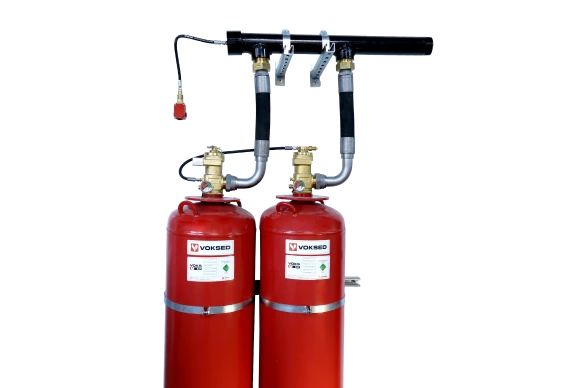
HFC 227ea is an effective fire extinguishing gas used in places with electrical and electronic devices. It extinguishes fires by inhibiting chemical reactions and absorbing heat. When detectors are activated, the system rapidly releases HFC-227ea gas into the protected area. The chemical formula of the gas is Heptafluoropropane. It is colorless and odorless, stored in cylinders at high pressure. Its usability comes from forming a layer on the combustible surface upon release through spray nozzles, preventing ignition.
FK 5-1-12 is a fire extinguishing gas used for extinguishing fires. It is non-conductive and leaves no residue when evaporated. It was developed as an alternative to Halon 1301, which was banned under the Montreal Protocol. It is a colorless, odorless, and non-conductive gas effective for extinguishing fires in electrical and electronic equipment as well as special hazard classes. It is approved by UL and FM. The NOAEL level for FK5-1-12 gas is accepted as above 10%, while the LOAEL level is above 10.5%.
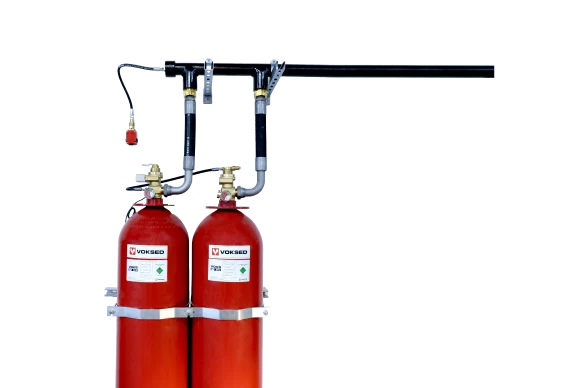
VOKS - IG is a colorless, odorless, and non-conductive gas. It occurs naturally in the atmosphere and suppresses fires by reducing oxygen. It does not harm the ozone layer and has no impact on global warming. It requires no cleaning after use and can be safely used in areas with people present. It can be stored in cylinders of various capacities and multiple areas can be extinguished simultaneously using directional valves. Single or multiple cylinders can be utilized, and it can be locally sourced and easily refilled.